



Recurrent Revascularization at 10 Years after Percutaneous Treatment of DES In-Stent Restenosis

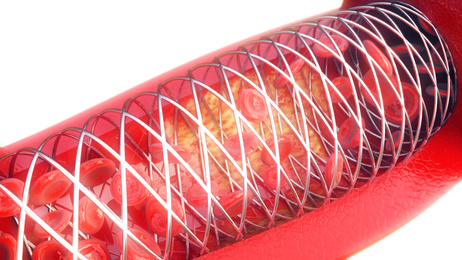
In stent restenosis (ISR) continues to be the main limitation to the percutaneous treatment of coronary artery disease, with 5 to 10% prevalence after new generation DES stenting. Guideline recommendations for this intervention include new DES stenting and the use of drug coated balloons (DCB). Recurrent ISR stenting rate ranges between 10 and 40%, and its treatment remains challenging. 
Revascularización recurrente a los 10 años luego del tratamiento de restenosis intrastent de DES

The aim of this post hoc analysis of the randomized ISAR-DESIRE 3 (Efficacy Study of Paclitaxel-Eluting Balloon, -Stent vs. Plain Angioplasty for Drug-Eluting Stent Restenosis) was to look into post DES stenting recurrent revascularization incidence at long term.

Primary end point was repeat target lesion revascularization (R-TLR), defined as any repeat revascularization: either with balloon (PCI) or CABG after recurrent ISR. 

At 10 year followup, total R-TLR was 373: 162 occurred in the plain balloon angioplasty (PB) group, 124 in the drug coated balloon (DCB) group and 87 in the DES stenting group. During the first year, the risk of R-TLR was reduced with DCB (HR: 0.36; CI  95%: 0.24-0.54) and DES (HR: 0.23; CI 95%: 0.14-0.38) vs. PB. 

Read also: Short-Term Outcomes of TAVR in Asymptomatic or Minimally Symptomatic Patients.

After year 1, R-TLR risk saw a significant reduction with DCB (HR: 0.77; CI 95%: 0.51-1.16) and DES (HR: 0.61; CI 95%: 0.39-0.95). Risk for DCB and DES was similar during (HR: 1.54; CI 95%: 0.89-2.69) and after (HR: 1.26; CI 95%: 0.82-1.92) the first year.

Conclusión 

Total R-TLR at 10 years was high. The use of DCB and DES reduce the need for primary and recurrent revascularization vs. plain balloon angioplasty.
Dr. Andrés Rodríguez.
Member of the Editorial Board of SOLACI.org.

Original Title: Recurrent Revascularization at 10 Years After Percutaneous Treatment of Drug-Eluting Stent Restenosis.

Reference: Tobias Koch, MD et al J Am Coll Cardiol Intv 2024;17:1–13.


Subscribe to our weekly newsletter

Get the latest scientific articles on interventional cardiology


More articles by this author

High Ischaemic Risk Criteria in Chronic Coronary Syndrome: Prevalence and Prognosis

Despite advances in the management of chronic coronary syndrome (CCS), including the widespread use of drug-eluting stents (DES) and the optimization of medical therapy,...

ACC 2026 | DKCRUSH VIII: IVUS or angiography to guide PCI in complex coronary bifurcations

Intracoronary imaging guidance has become an established recommended strategy in complex coronary lesions. In the specific setting of complex bifurcations, uncertainty remained regarding the...

ACC 2026 | OPTIMAL: IVUS Guidance in PCI of the Unprotected Left Main Coronary Artery

Percutaneous coronary intervention (PCI) is considered an equivalent alternative to coronary artery bypass surgery in patients with left main coronary artery (LMCA) stenosis and...

ACC 2026 | IVUS-CHIP Trial: Intravascular ultrasound–guided versus angiography-guided complex PCI

Optimization of percutaneous coronary intervention (PCI) in complex lesions remains a relevant clinical challenge. In this context, the IVUS-CHIP trial was designed to evaluate...

LEAVE A REPLY

Please enter your comment!
Please enter your name here

Related Articles

SOLACI Sessionsspot_img

Recent Articles

High Ischaemic Risk Criteria in Chronic Coronary Syndrome: Prevalence and Prognosis

Despite advances in the management of chronic coronary syndrome (CCS), including the widespread use of drug-eluting stents (DES) and the optimization of medical therapy,...

Management of Valve Thrombosis in TAVI: Current Evidence-Based Approach

The expansion of transcatheter aortic valve implantation (TAVI) into younger and lower-risk populations has brought bioprosthetic valve thrombosis to the forefront as a clinically...

Experience with the intra-annular self-expanding Navitor valve: data from the STS/ACC TVT registry

The expansion of TAVI, with the introduction of new-generation devices, has prioritized not only periprocedural safety, but also the preservation of coronary access, more...

