



Modelos europeos de telemedicina, como el servicio finlandés Medilux, permiten realizar consultas médicas online mediante un cuestionario clínico, sin acudir a una consulta presencial.

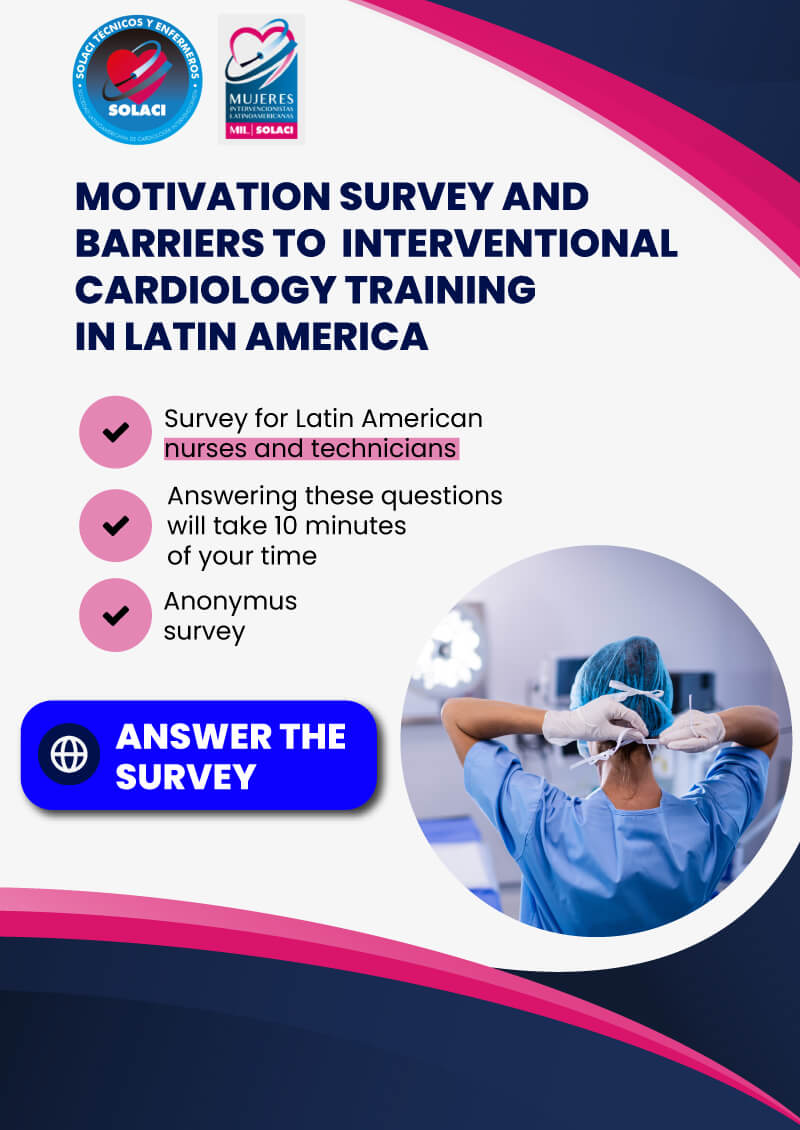
Motivation Survey and Barriers to Interventional Cardiology Training in Latin America for Nurses and Technicians

The SOLACI Chapter of Technicians, Nurses and Medical Technologists invites you to answer this short survey to learn more about us and discover what the barriers and motivations are in our continent to pursue a career in interventional cardiology.

Answering the survey will take you no more than 10 minutes and is anonymous.

Subscribe to our weekly newsletter

Get the latest scientific articles on interventional cardiology

More articles by this author

Everything You Need to Know About Panama Sessions 2026

After 7 years, SOLACI returns to Panama to host its 54th Regional Sessions, in collaboration with the Panamanian Association of Hemodynamics and Interventional Cardiology...

Call For Science SOLACI & SBHCI 2026 – Submit Your Work!

We invite you to submit scientific papers and challenging clinical cases for the SOLACI & SBHCI 2026 Congress, taking place from July 29 to...

FAC Webinar | CTEPH: one disease, three strategies, one team,

The Latin American Society of Interventional Cardiology (SOLACI) invites you to participate in the upcoming webinar organized by the Heart Failure Committee of the...

Mourning the passing of Dr. Eugene Braunwald

From the Latin American Society of Interventional Cardiology (SOLACI), we deeply regret the passing of Dr. Eugene Braunwald, a central figure in the development...

LEAVE A REPLY

Please enter your comment!
Please enter your name here

Related Articles

SOLACI Sessionsspot_img

Recent Articles

KISS Trial: provisional stenting in non-left main coronary bifurcations — is less more?

Coronary bifurcation angioplasty remains one of the most frequent and technically challenging scenarios in interventional cardiology. Between 15% and 20% of coronary procedures involve...

Complex radial access: a four-step protocol to overcome loops and tortuosity

Radial access is currently the preferred strategy for coronary angiography and percutaneous coronary interventions due to its lower rates of bleeding and vascular complications...

Percutaneous closure of paravalvular leaks in high-risk patients: clinical outcomes and the impact of residual leak

Paravalvular leak (PVL) is a relatively frequent complication following valve replacement (overall incidence 5–18%; 2–10% in the aortic position and 7–17% in the mitral...

