



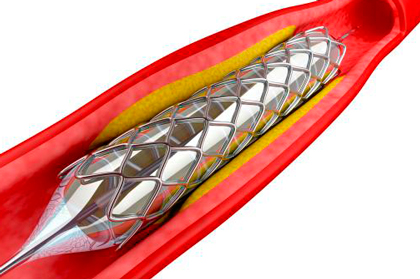
PRISON IV: DES with resorbable polymer vs. DES with permanent polymer in total occlusions

Courtesy of SBHCI.

PRISON IV: DES with Resorbable Polymer vs. DES with Permanent Polymer in Total OcclusionsThe PRISON IV trial compared the sirolimus eluting stent with ultra-thin struts and biodegradable polymer vs. the second-generation everolimus-eluting stent with thin struts and durable polymer in successfully recanalized chronic total occlusions. This is a sub-study with optical coherence tomography (OCT).


The study included 330 patients, 85% angiographically followed up at 9 months. In addition, 60 of these patients were evaluated with OCT.


Minimal lumen area, minimal stent area, maximal neointimal area and neointimal thickness were similar with both devices. The percentage of uncovered struts was significantly higher for the everolimus eluting stent (p=0.04), while the percentage of malapposed struts was higher for the sirolimus eluting stent (p=0.004).


Conclusion

This substudy with OCT in patients undergoing CTO stenting showed higher strut coverage for the ultra-thin sirolimus eluting stent with degradable polymer, though with higher malapposition. The clinical relevance of these findings has not yet been shown.


Courtesy of SBHCI.

 

Dr. Koen Teeuwen
Dr. Koen Teeuwen.

Original Title: Optical coherence tomography findings: insights from the “randomised multicentre trial investigating angiographic outcomes of hybrid sirolimus-eluting stents with biodegradable polymer compared with everolimus-eluting stents with durable polymer in chronic total occlusions” (PRISON IV) trial.

Presenter: Koen Teeuwen.


Dr.KoenTeeuwen

Subscribe to our weekly newsletter

Get the latest scientific articles on interventional cardiology

We are interested in your opinion. Please, leave your comments, thoughts, questions, etc., below. They will be most welcome.


More articles by this author

ACC 2026 | DKCRUSH VIII: IVUS or angiography to guide PCI in complex coronary bifurcations

Intracoronary imaging guidance has become an established recommended strategy in complex coronary lesions. In the specific setting of complex bifurcations, uncertainty remained regarding the...

ACC 2026 | OPTIMAL: IVUS Guidance in PCI of the Unprotected Left Main Coronary Artery

Percutaneous coronary intervention (PCI) is considered an equivalent alternative to coronary artery bypass surgery in patients with left main coronary artery (LMCA) stenosis and...

ACC 2026 | IVUS-CHIP Trial: Intravascular ultrasound–guided versus angiography-guided complex PCI

Optimization of percutaneous coronary intervention (PCI) in complex lesions remains a relevant clinical challenge. In this context, the IVUS-CHIP trial was designed to evaluate...

ACC 2026 | ALL-RISE Trial: Coronary Physiological Assessment Using FFRangio

Coronary physiological assessment using pressure-wire techniques (FFR/iFR) carries a Class IA recommendation in ACC/AHA guidelines; however, its use remains limited due to factors such...

LEAVE A REPLY

Please enter your comment!
Please enter your name here

Related Articles

SOLACI Sessionsspot_img

Recent Articles

Therapeutic strategies in carotid free-floating thrombus: evidence and controversies

Carotid free-floating thrombus (cFFT) is a rare entity with a high embolic risk, associated with acute neurological events such as stroke or transient ischemic...

The Two Sides of the Coin: What Do CHAMPION-AF and CLOSURE-AF Teach Us About Left Atrial Appendage Closure?

Letter to the editor: Juan Manuel Pérez Asorey Percutaneous left atrial appendage closure (LAAO) is currently going through one of the most interesting stages of...

CLOSURE-AF: Percutaneous Left Atrial Appendage Closure versus Medical Therapy in Atrial Fibrillation

Percutaneous left atrial appendage closure has been proposed as an alternative to anticoagulation in patients with atrial fibrillation and high bleeding risk; however, comparative...
